Skip permits explained: who applies, what it costs, what goes wrong
When a skip needs a council permit, who applies for it, what it costs across ten councils, the lighting and marking rules, and what happens when it runs out.

LoadSnap team
Running a waste business
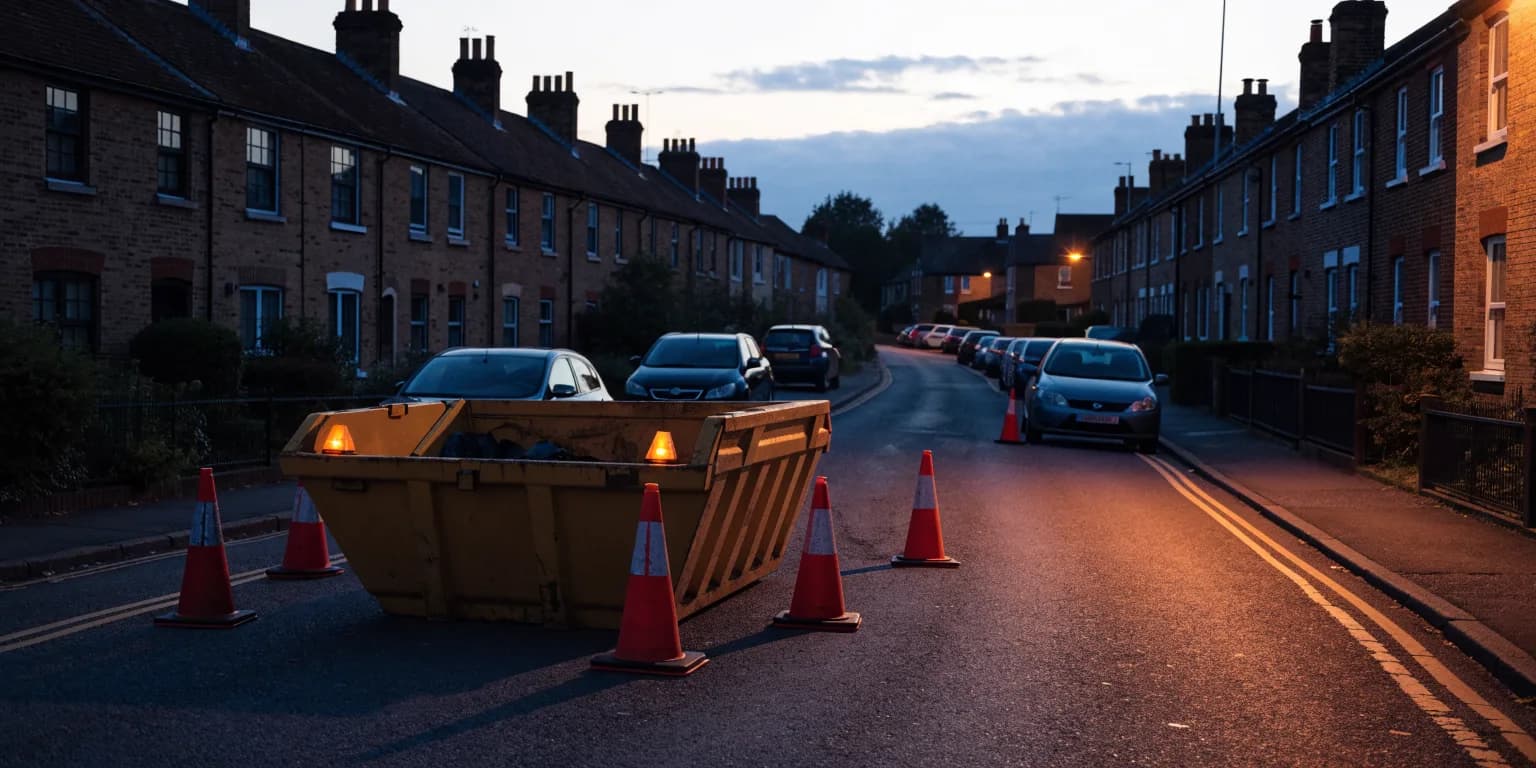
A skip on a driveway needs nothing from the council. Put the same skip on the road and it needs a permit, lights, markings and the right paperwork, and the fines land on the skip firm. Here is how it works, written so you can forward it to customers.
Do I need a permit for a skip?
Yes, if any part of it stands on the public highway. That means the road, and also the pavement and the grass verge, which count as highway too. No, if it sits entirely on private land, such as a driveway or a front garden.
In England and Wales the rule is section 139 of the Highways Act 1980: a builder's skip must not be put on a highway without the permission of the highway authority, which is the council. In Scotland the same rule sits in section 85 of the Roads (Scotland) Act 1984, and you need the roads authority's written permission.
Who applies, and how long it takes
The skip firm. The law puts the duties that come with a road skip, the lighting, the markings, the name on the side and moving it when it is full, on the skip's owner. For an ordinary hire of less than a month, that is the skip firm, not the customer. Most councils go further and only take applications from skip companies: Sheffield will not accept one from the person hiring the skip, and Bristol only from the company that owns it.
Notice periods vary a lot. Lancashire and Liverpool ask for two working days, Bristol and Carmarthenshire five, Argyll and Bute seven and Devon ten. That is why a customer ringing on Friday afternoon for a road skip on Saturday is a problem. Ask "drive or road?" when you take the booking, every time.
What it costs
| Council | Fee | What it covers |
|---|---|---|
| Sheffield | £17 | Up to 15 days. Another 15 days costs £17. |
| Argyll and Bute | £39 | Per skip |
| Lancashire | £42 | 28 days |
| Liverpool | £44 | Up to 7 days, then a new permit |
| Bradford | £48 | 14 days, or 6 days on a narrow street |
| Carmarthenshire | £75 | A month or part of one |
| Lambeth | £80 | Per licence |
| Bristol | £90 | A calendar month |
| Devon | £110.50 | Standard application. Less than 10 days' notice costs £166, a change £87. |
| Havering | £162 | 14 days. Another 7 days costs £110. |
So a permit can cost anything from under £20 to over £160, and the period it covers runs from a week to a month. Two things are not in that fee. In London and city centres you may also need a parking bay suspension, which can cost far more than the permit. And extending a permit usually means paying again, so price long hires with that in mind.
Lights, cones and markings
Section 139 says a skip on the highway must be:
- Lit during the hours of darkness.
- Marked with the owner's name and phone number or address.
- Fitted with marking plates. The Builders' Skips (Markings) Regulations 1984 require two plates on each end, with red fluorescent and yellow reflective diagonal stripes, the top edge no higher than 1.5 metres from the ground.
- Moved as soon as practicable once it is full.
Councils add their own conditions on top. Lancashire's are typical: at least four cones on the approach side, and lamps on the corners of the skip and between the cones from half an hour before sunset to half an hour after sunrise. Many councils also ask for public liability cover, £5 million in Bristol and £10 million in Carmarthenshire.
When the permit runs out before the skip is collected
An expired permit is the same as no permit. Putting a skip on the highway without permission, or breaking the lighting and marking rules, is an offence with a fine of up to level 3 on the standard scale, which is £1,000. Under section 140 the council or a uniformed police officer can order the owner to move it, remove it themselves if the owner does not, and recover the cost from the skip firm.
Some councils also charge more for a permit after the event. Bradford charges £168 for a retrospective licence, and Carmarthenshire £214 a month for a late renewal, nearly three times the normal fee.
The fix is boring and it works: put the permit number and expiry date on every road skip job, and check them before the driver goes out. LoadSnap keeps the permit number and expiry on the job, and shows them to the driver in the cab, with a warning if a road skip has no permit.
Questions people ask
How much is a skip permit?
Between £17 and £162 in our sample of ten councils, for anything from a week to a month. Ring the skip firm, which applies and adds it to the price.
Can I put a skip on the road without a permit?
No. It is an offence carrying a fine of up to £1,000, and the council can remove the skip and charge for it.
Does a skip on a driveway need a permit?
No, as long as no part of it overhangs the pavement or road.
Starting out?
See every licence a skip firm needs, with real costs, in how to start a skip hire business.
LoadSnap team
Running a waste business
Written by the team building LoadSnap, the UK waste compliance platform for carriers and receivers.
Keep reading

Do you need to report the waste you receive? DEFRA's guidance, read from the weighbridge
Oct 8, 2026 · 8 min

Upper tier or lower tier: which waste carrier licence you need and what it costs
Oct 4, 2026 · 5 min

Season tickets: when one transfer note can cover a year
Oct 4, 2026 · 5 min
Digital waste tracking is live
The mandate is here.
Automate compliance.
Receiving sites in England and Wales have had to record every load digitally since 1 October 2026. Start a 14-day free trial in minutes, cancel any time before it ends, and file every load from day one.
DEFRA API integrated · EA carrier verification · UK data residency